

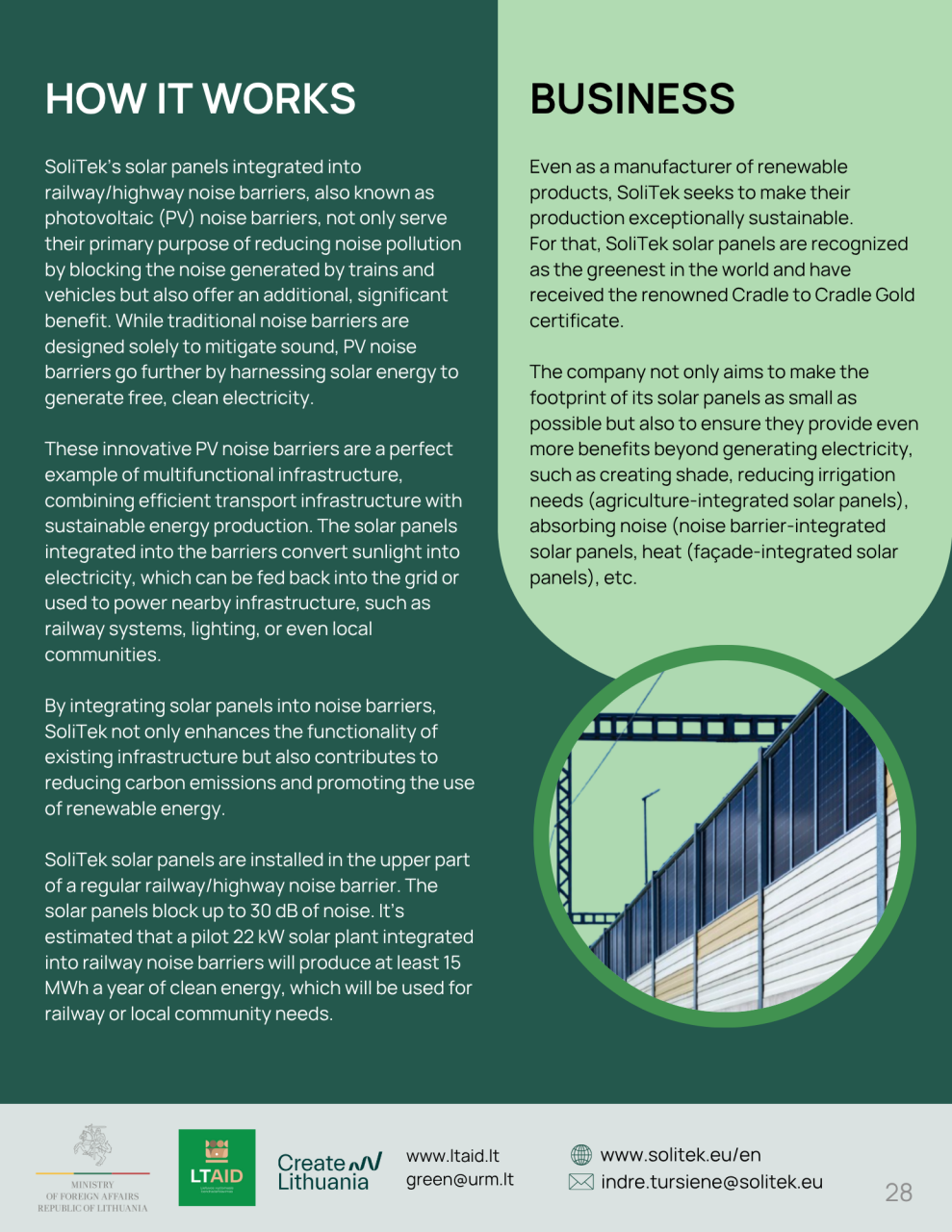
a solar power solution to power railway/highway noise barriers. Solar-integrated noise barriers become dual-purpose: block the noise from trains/cars and generate free electricity simultaneously.
SoliTek’s solar panels integrated into railway/highway noise barriers, also known as photovoltaic (PV) noise barriers, not only serve their primary purpose of reducing noise pollution by blocking the noise generated by trains and vehicles but also offer an additional, significant benefit. While traditional noise barriers are designed solely to mitigate sound, PV noise barriers go further by harnessing solar energy to generate free, clean electricity.
These innovative PV noise barriers are a perfect example of multifunctional infrastructure, combining efficient transport infrastructure with sustainable energy production. The solar panels integrated into the barriers convert sunlight into electricity, which can be fed back into the grid or used to power nearby infrastructure, such as railway systems, lighting, or even local communities.
By integrating solar panels into noise barriers, SoliTek not only enhances the functionality of existing infrastructure but also contributes to reducing carbon emissions and promoting the use of renewable energy.
SoliTek solar panels are installed in the upper part of a regular railway/highway noise barrier. The solar panels block up to 30 dB of noise. It’s estimated that a pilot 22 kW solar plant integrated into railway noise barriers will produce at least 15 MWh a year of clean energy, which will be used for railway or local community needs.
Customizable. Approx. 15% more expensive than standard noise barriers.
Europe, United States.
Ukraine, African and other developing countries.
Pilot.
Even as a manufacturer of renewable products, SoliTek seeks to make their production exceptionally sustainable.
For that, SoliTek solar panels are recognized as the greenest in the world and have received the renowned Cradle to Cradle Gold certificate.
The company not only aims to make the footprint of its solar panels as small as possible but also to ensure they provide even more benefits beyond generating electricity, such as creating shade, reducing irrigation needs (agriculture-integrated solar panels), absorbing noise (noise barrier-integrated solar panels, heat (façade-integrated solar panels), etc.
